
Variation margin — controlled.
FYLTA is an Excel-based control system that makes variation profit visible and enforced before decisions are locked in.
Used daily by PMs. Read instantly by directors.
Order, Enforced.
Built natively in Excel. No new software. No cultural reset.
Request Early Access
Variations don’t fail loudly. They fail quietly.Not through mistakes —
through delays, small concessions, and approvals that feel harmless at the time.Each step looks reasonable in isolation.
Collectively, they trade margin away.By the time it’s visible in a cost report, the decision has already been made.
This is not a cost problem.
It’s a control problem.

Everyone assumes the process is under control — until the numbers say otherwise.
In reality, control is fragmented across emails, registers, and memory.
Margin is traded away quietly — one approval at a time.
The rule FYLTA enforces
Every change is either controlled — or rejected.FYLTA enforces a single rule across variations:
if it changes value, scope, or margin, it must move through a visible state.Nothing is overwritten.
Nothing is implied.
Nothing becomes “real” by accident.
Spreadsheets don’t fail. Discipline does.
Not another platform. A control layer.
FYLTA doesn’t replace Procore, Jobpac, or your accounting system.Those tools track activity and numbers.
They don’t enforce operational discipline around variations.FYLTA is the layer that locks everything together —
before chaos compounds.
What’s available at launch
FYLTA launches with a complete variation control system — focused on profit visibility, approval enforcement, and stopping margin erosion before it settles.This is not a general-purpose PM platform.
It’s a deliberately scoped control layer for where projects quietly win or lose money.
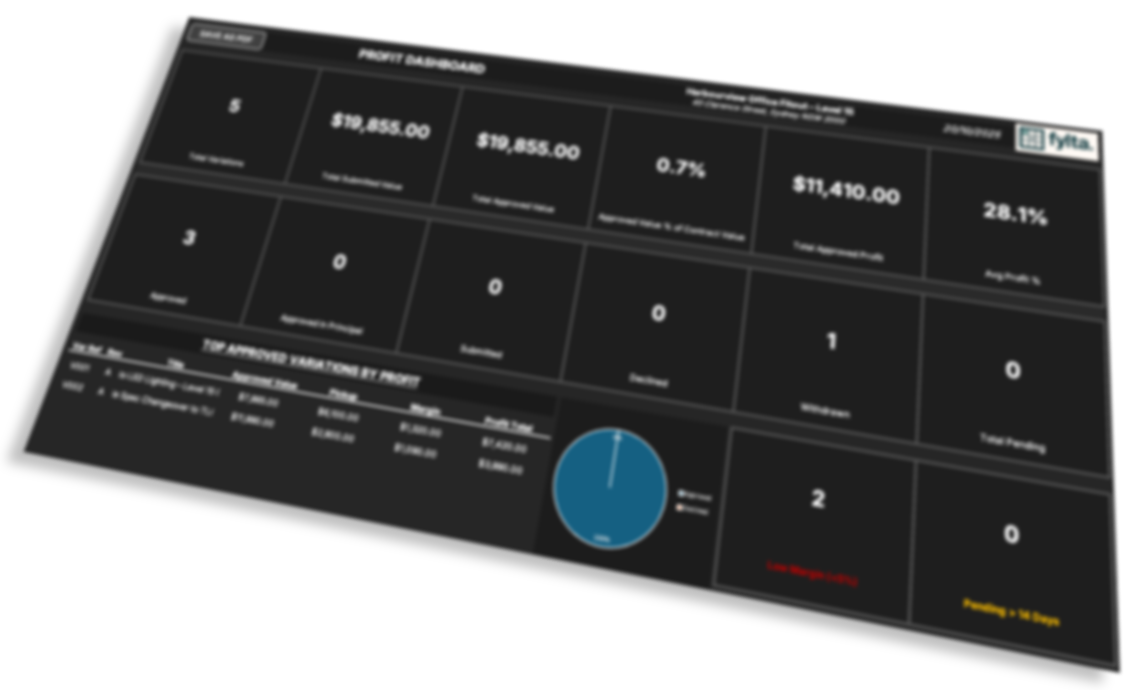
Profit visibility
This is the core of the system.Most variation registers show values.
Very few show profit consequence at the moment decisions are made — when it can still be controlled.FYLTA gives directors:
• Internal margin visibility before approval settles
• Clear separation between:
• submitted value
• approved value
• internal cost
• resulting margin / contingency position
• Margin impact aggregated across the project — not buried in individual line itemsDirectors don’t have to wait for month-end to discover what was quietly given away.They can see, in real time, whether margin is being protected — or gradually surrendered.Enforced statesOnce a decision is made, it can’t quietly move.This is where most spreadsheets quietly fail.Typical Tier-3 registers allow:
• statuses to be changed at any time
• values to be overwritten
• history to be implied rather than enforcedFYLTA enforces structure:
• Submissions are stamped at the moment they are issued
• Approved states are locked
• Revisions are explicit — not overwritten
• There is a clear “before” and “after” to every approvalThis creates decision gravity.Once something is approved, it becomes real — and stops being quietly renegotiated.Clarity without chasing
FYLTA separates operational detail from executive signal.Project teams work in the detail.
Directors see outcomes — without living inside the spreadsheet.Dashboards answer the questions directors and managers constantly ask:
• How much variation value is still unapproved?
• How much margin is currently at risk?
• Where is approval lag affecting cashflow?
• Which trades are consistently eroding margin?All of this lives in one system:
• the register
• the submission sheets
• the cover content
• the values, dates, and approval states
• the dashboardsNo duplicate entry.
No version confusion.
No “which one is current?”If someone leaves, the system still tells the truth — without reconstruction or guesswork.What comes next
RFIs, submittals, and broader cost control will follow.Variation control comes first —
because that’s where profit is won or lost.Used alone, it tracks.
Installed properly, it enforces.
Frequently Asked Questions
Who is FYLTA built for?FYLTA is built for Tier-3 builders managing commercial projects where variation control directly affects margin, cashflow, and risk.
It’s used daily by Project Managers and Contract Administrators, and reviewed by Directors for oversight and decision-making.⸻Is FYLTA software, or an Excel system?FYLTA is an Excel-based operational control system.It works natively inside Excel to reduce resistance, speed adoption, and avoid introducing another platform — while still enforcing discipline and structure.At its core, FYLTA functions as an Excel-based construction variation register, with enforced states, margin visibility, and executive dashboards.⸻How is this different from a normal variation register?Most variation registers record information.
FYLTA enforces states, separates revisions, and makes margin impact visible before approvals are locked in — not after the fact.⸻Does FYLTA replace Procore, Jobpac, or our accounting system?No.
FYLTA sits alongside existing systems as a control layer, bridging the gap between variation activity and real profit impact.⸻Do Project Managers need to do more work to use FYLTA?PMs provide clearer inputs upfront — to prevent margin loss and rework later.
The system shifts effort earlier to prevent margin loss downstream.⸻How does FYLTA show profit or contingency impact?FYLTA separates submitted value, approved value, internal cost, and resulting margin.
This allows directors to see whether variations are covered by contingency or eroding profit — at the moment decisions are made.⸻Is everything fully auditable with timestamps?FYLTA enforces submission and approval states and records when variations are formally issued.
It focuses on decision control and clarity rather than excessive time-stamping that creates noise without insight.⸻How is FYLTA implemented?FYLTA can be used immediately as a register.
For full enforcement, workflow setup and system configuration are offered to align the system with how your business actually operates.
Control isn’t bought. It’s installed.
FYLTA consulting is not advice.
It’s implementation.We audit how variations actually move through your business, then; we install a disciplined control workflow, configure FYLTA to match your reality and remove ambiguity around responsibility and timing
The outcome: fewer surprises, faster approvals, protected margin.
Built inside real projects
FYLTA was developed inside live commercial projects —
not as a startup concept, not as a sales pitch.It’s built from production reality:
tight timelines, imperfect information, and zero tolerance for fluff.
Early access is now open.
Join the waitlist for first access to the FYLTA variation control System and control setup services.
Already over 30 builders waiting.
Director? Request a 15-minute variation control review.
Built by builders.
Fifteen years inside Tier-3 commercial fit-out and construction teams.
Tired of duct-taped spreadsheets and overpriced software.
So we built the system we wished we had.